
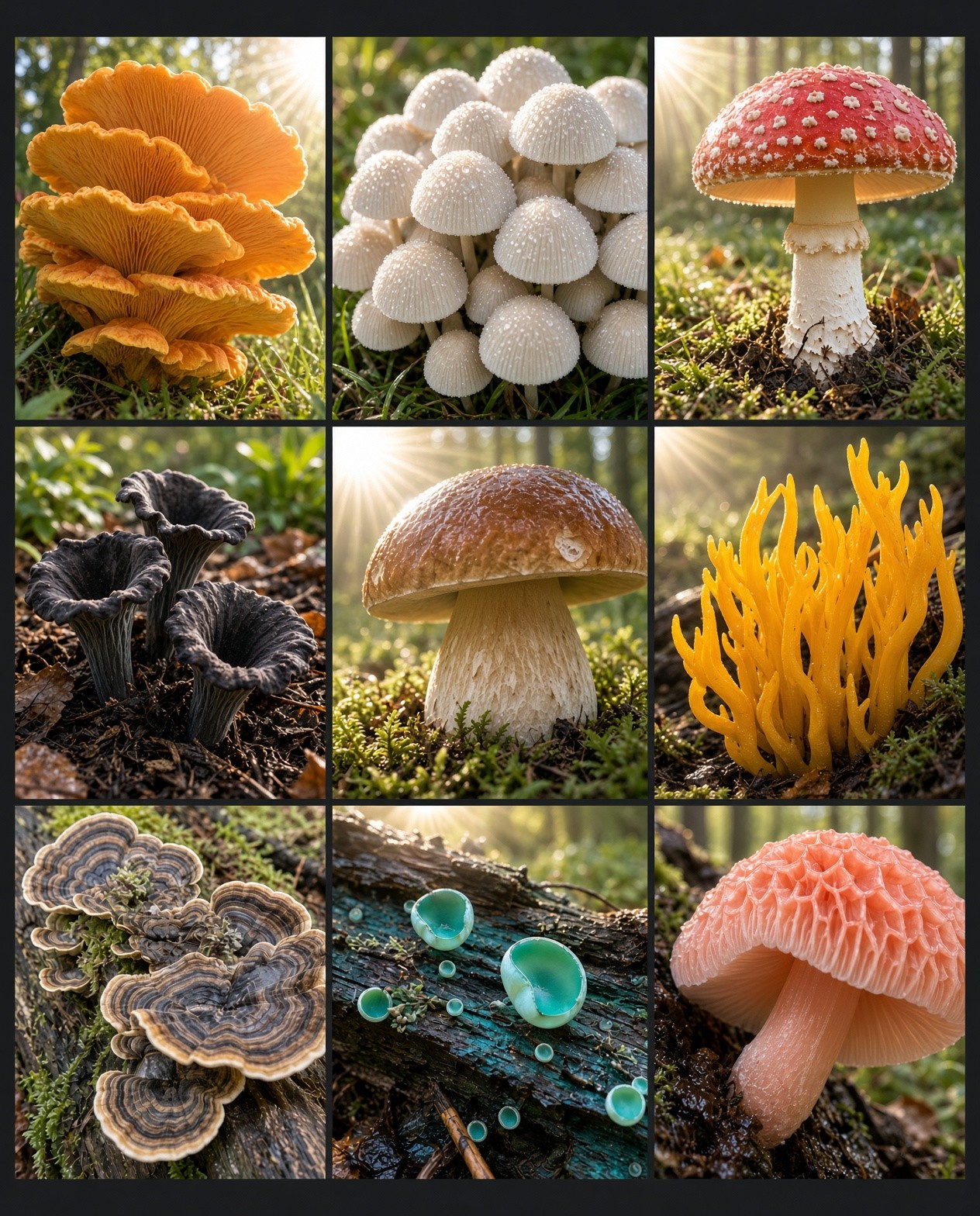
October can transform a familiar woodland path into a miniature natural-history exhibition. After autumn rain, mushrooms appear in leaf litter, colorful caps emerge from moss, and delicate fungi spread across fallen branches. Some are easy to spot from a distance; others reward anyone willing to slow down and look closely.

Fungi are more than decorative woodland finds. Their underground networks help decompose dead material, recycle nutrients, and form relationships with plants and trees. The visible mushroom is the fruiting body of a much larger organism, and it may last only a short time. What you see depends on rainfall, temperature, habitat, and the trees nearby.
Fly Agaric: The Classic Red Woodland Mushroom
Fly agaric (Amanita muscaria) is one of autumn’s most recognizable fungi. Its bright red or orange cap and pale spots stand out against moss and fallen leaves. In October, look for it in woodland near birch, pine, or spruce, with which it forms important underground partnerships. The cap’s color and spots may vary with age and weather, so appearance alone is never enough for identification. Fly agaric is toxic: admire it in place, photograph it without disturbing the soil, and keep children and pets from tasting it.

Honey-Colored Mushrooms on Old Wood
Clusters of honey-brown mushrooms may appear on stumps, fallen trunks, or around tree bases. Some belong to the honey fungus group (Armillaria species). These fungi help decompose dead wood, returning nutrients to the woodland, although some can also harm living trees. Many unrelated fungi share similar colors, so a golden cluster should never be identified by color alone. Observe what it grows on, take a photograph, and leave it undisturbed unless studying it with a qualified specialist.

The Jewel-Like Amethyst Deceiver
Amethyst deceiver (Laccaria amethystina) can add a vivid purple note to damp leaf litter. Its cap, stem, and gills may be violet when fresh, then fade as the mushroom ages or dries. Search gently around broadleaf trees in leafy, mossy woodland. This small species shows how much fungi can change with moisture and age. Photograph it from several angles and record its habitat, but avoid pulling it up: the visible mushroom is only one part of a larger organism in the soil.

Orange Jelly Fungus on Fallen Branches
Orange jelly-like fungi look like tiny amber drops on wet, decaying wood. Several species have this form, sometimes shrinking during dry weather and swelling again after rain. Look closely at fallen branches and logs rather than expecting every fungus to have a cap and stem. Their bright texture makes them excellent subjects for close-up photography. Keep the branch where it lies and follow local rules in nature reserves, where collecting may be prohibited.

Shaggy Inkcap: A Mushroom That Changes Quickly
The shaggy inkcap (Coprinus comatus), sometimes called lawyer’s wig, has a tall white cap covered with shaggy scales. As it matures, the cap darkens at the edges and dissolves into black, inky liquid that releases spores. It may grow in lawns, parks, grassy verges, and disturbed ground in mild autumn weather. Its quick transformation is fascinating to watch, but a single photo cannot establish safe identification. Avoid picking mushrooms from treated lawns or roadside verges, and never eat a wild specimen without expert confirmation.

Turkey-Tail Brackets on a Log
Turkey-tail fungi (Trametes versicolor) form thin, fan-shaped shelves with bands of cream, gray, brown, rust, and sometimes blue-green. They commonly grow in overlapping layers on dead hardwood. Their striped surfaces resemble tiny fans, and the underside has pores rather than the gills found under many mushrooms. These fungi help break down wood and recycle nutrients. Photograph the top and underside when naturally visible, and leave the log intact so the fungus can continue its work.

Bird’s-Nest Fungi: Tiny Natural Cups
Bird’s-nest fungi are tiny cup-shaped fruiting bodies found on damp mulch, rotting twigs, and decaying plant debris. Each cup holds bead-like structures called peridioles, which contain spores. Raindrops can splash these packets outward, helping the fungus spread. Their small size means they are easy to overlook until you kneel down. Use a close-up photograph and soft natural light, and avoid scraping away the surrounding moss or litter to get a better view.

Pale Oyster-Like Fungi on Tree Trunks
Pale, fan-shaped fungi growing from a trunk or fallen log may resemble oyster mushrooms, with layered caps and gills running down a short or absent stem. Several species look similar, and accurate identification depends on multiple features, including the underside, host wood, and local distribution. Their layered shapes create beautiful patterns against dark bark. Never assume a white or oyster-shaped fungus is edible: dangerous lookalikes exist, and online photos are not enough for safe food identification.

The Hidden Variety of the October Forest Floor
Not every autumn fungus has a bright cap. Look for pale miniature mushrooms in moss, delicate cups on twigs, coral-like branches, puffballs, and caps half-hidden under leaves. Different species respond to rainfall, temperature, soil, and nearby trees, so one woodland path can change over several weeks. Walk slowly, photograph fungi in place, and record the date, weather, habitat, and nearby trees in a nature journal. These notes build observation skills without needing to collect or consume anything.
How to Observe Autumn Fungi Responsibly
You do not need to pick mushrooms to enjoy them. Walk slowly, check the sides of fallen logs as well as the ground, and use your phone camera to capture details without disturbing the specimen. Photograph the cap, stem, underside when naturally visible, and the surrounding habitat.
- Leave the habitat intact. Avoid pulling up fungi, breaking branches, or scraping away moss and leaf litter.
- Watch your step. Small fungi may be hidden beside paths, and damp woodland soil can be slippery.
- Respect local rules. Parks, reserves, and private land may restrict collecting.
- Keep children and pets from tasting fungi. If someone eats a wild mushroom, contact local emergency or poison-control services promptly.
- Record observations. Note the date, weather, habitat, and nearby trees to compare what appears through the season.
Why October Is Such a Good Month for Fungi
Many fungi fruit when moisture is available and temperatures are suitable. Autumn often brings cool nights, damp ground, decaying leaves, and plenty of dead wood. These conditions encourage many species to produce visible fruiting bodies. Rain can make colors brighter and textures more obvious, although heavy rain may wash away identifying features or damage delicate caps.
Fungi do not follow a universal calendar. A warm, dry October may produce fewer visible mushrooms than a mild, rainy one, and species found in one country may be absent elsewhere. Treat this list as inspiration rather than a guarantee that every species will be present near you.
Frequently Asked Questions
Are all mushrooms that appear in October edible?
No. Autumn includes edible, inedible, poisonous, and potentially deadly fungi. Season, color, and habitat cannot establish edibility.
Can an identification app tell me what is safe to eat?
An app can suggest possibilities for learning, but it cannot reliably confirm a wild mushroom is safe to eat. Expert in-person identification is essential.
Should I remove mushrooms growing in my garden?
Usually, mushrooms are temporary signs that fungi are breaking down organic material in soil or mulch. If they are not causing a practical problem, leaving them supports natural decomposition. Keep children and pets from eating them.
What is the best way to photograph fungi?
Use soft natural light, get down to the mushroom’s level, and take both a close-up and a wider habitat photograph. Avoid moving or damaging the fungus.
Final Thoughts
From the striking red cap of fly agaric to the miniature cups of bird’s-nest fungi, October offers countless reasons to look more closely at the woodland floor. These organisms are beautiful, varied, and essential to healthy ecosystems. Take photographs, learn local species from trusted natural-history sources, and leave fungi where they grow. The best autumn discovery is one that lets both you and the woodland thrive.