
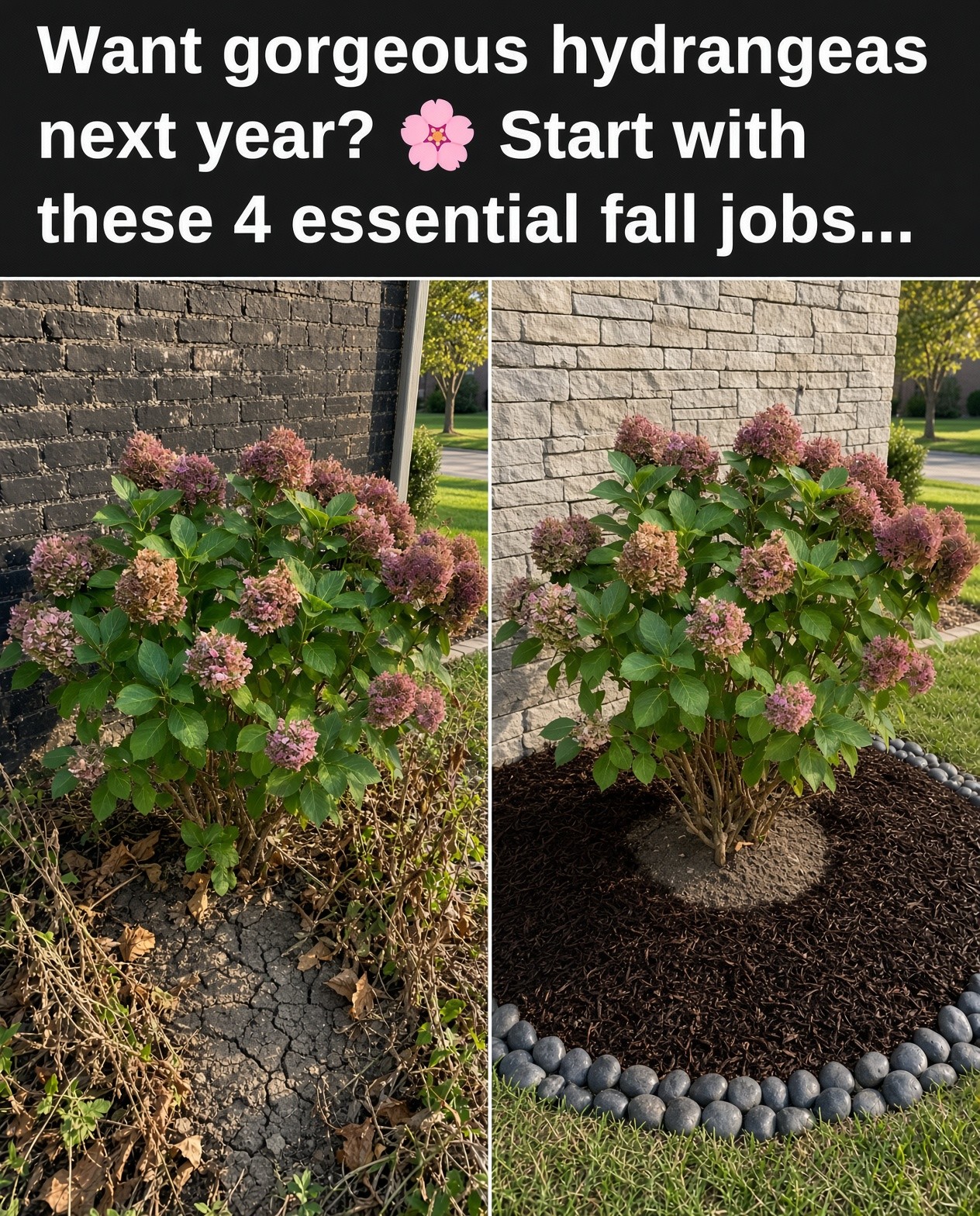

Fall Hydrangea Care: The Goal Is to Protect Next Year’s Growth
Fall is an important transition period for hydrangeas, but the right care depends on the kind of hydrangea you grow. The biggest mistake is treating every hydrangea the same. Bigleaf, mountain and oakleaf hydrangeas can carry next year’s flower buds on older stems, while smooth and panicle hydrangeas produce flowers on new growth. That difference determines whether fall pruning is helpful or harmful. Instead of trying to “clean up” the shrub as soon as temperatures drop, use autumn to protect the root zone, maintain adequate moisture, prepare for cold weather and avoid removing stems that may already contain next season’s flower buds. A little restraint can be more valuable than aggressive pruning.

1. Check the Stems Before You Cut Anything
The first fall job is simply to look closely at the plant. As leaves begin to fall, the structure of a hydrangea becomes easier to see, including the stems that will carry next season’s growth. If you have a bigleaf or mountain hydrangea, be especially cautious: these types can form their next flower buds on old wood before winter arrives.
That means a pair of pruners can remove more than dead branches. A cut can also remove flower buds that would otherwise open the following summer. Penn State Extension notes that bigleaf hydrangeas begin setting next year’s flowers after they finish blooming, and fall pruning can therefore lead to few or no flowers the next season.
If you are unsure which hydrangea you own, identifying the cultivar before pruning is the safest approach. When in doubt, postpone major pruning until you can confirm whether the plant blooms on old wood or new wood.

2. Avoid Routine Fall Pruning on Old-Wood Hydrangeas
For bigleaf, mountain and oakleaf hydrangeas, fall is generally not the time for a hard cutback. These shrubs can carry flower buds through winter on stems produced during the previous growing season. Removing those stems in autumn can reduce the number of flowers next year.
Instead, remove only material that is clearly dead, broken or diseased when there is a good reason to do so, and avoid shortening healthy stems simply because the shrub looks untidy. The dried flower heads can also be left in place for winter interest.
There are exceptions among cultivars. Some reblooming bigleaf hydrangeas, including members of the Endless Summer group, can flower on both old and new wood. Even then, unnecessary fall pruning is usually not needed. The safest rule is to identify the plant first and prune according to its flowering habit.

3. Protect Tender Hydrangeas From Hard Frost
Cold protection becomes especially important for bigleaf hydrangeas in regions where winter temperatures can damage flower buds. The plant itself may survive a cold spell while the exposed buds are injured, leaving you with healthy green growth but very few flowers the following season.
In colder or exposed gardens, temporary protection can help during severe freezes. A breathable frost cloth or burlap can be draped over the shrub when a hard freeze is expected, then removed when temperatures moderate. Avoid leaving a sealed plastic cover against the foliage for extended periods.
Protection is most useful when it responds to real cold risk rather than being applied constantly. A light frost does not automatically mean a hydrangea needs to be wrapped. Know your local climate and the hardiness of your cultivar, and pay particular attention to newly planted or exposed shrubs.

4. Refresh the Mulch Around the Root Zone
A fresh layer of organic mulch is one of the simplest fall improvements for hydrangeas. Mulch helps moderate soil temperatures, reduces evaporation and limits competition from weeds. It can also reduce the rapid temperature changes that occur when exposed soil repeatedly freezes and thaws.
Spread roughly 2 to 3 inches of mulch over the root zone, using materials such as shredded bark, wood chips or another suitable organic mulch. Keep the mulch pulled back from the main stems rather than piling it directly against the crown.
Deep mulch is not better. Excessive layers can keep soil overly wet, reduce oxygen around roots and create other problems. A moderate, evenly distributed layer gives the roots insulation without creating a damp mound around the plant.

5. Improve the Soil Without Forcing Late Growth
Fall is a good time to pay attention to soil condition, but that does not mean hydrangeas need a heavy dose of fertilizer. Late-season nitrogen can encourage tender new growth that has not had enough time to harden before freezing weather.
If your soil benefits from organic matter, a light surface application of finished compost can be more appropriate than a strong nitrogen-rich fertilizer. Spread it around the plant rather than directly against the stems, and let rainfall and soil organisms gradually incorporate it.
For established shrubs, fertilizer decisions should be based on the plant’s growth and soil conditions rather than a calendar alone. If a hydrangea is growing well, pushing extra fertilizer in late fall is unlikely to improve winter performance and may encourage growth at the wrong time.

6. Know When to Stop Fertilizing
Hydrangeas do not need a “last feeding” simply because autumn has arrived. The goal as the growing season ends is to allow the plant to transition toward dormancy rather than stimulate a flush of soft new shoots.
University of Minnesota Extension cautions against late-summer nitrogen applications unless a plant is actually nutrient deficient, because extra nitrogen can promote growth that may not harden properly before winter. For hydrangeas, this is another reason to avoid using fertilizer as a routine fall rescue treatment.
If your shrub has poor growth, pale leaves or other signs of nutrient problems, address the underlying cause rather than guessing with fertilizer. A soil test can be much more useful than repeatedly adding nutrients without knowing what the soil contains.

7. Give the Root Zone a Thorough Watering
Hydrangeas prefer consistent moisture during active growth, and going into winter with very dry soil can be stressful, especially for recently planted shrubs. Before the ground freezes in cold climates, check the soil around the root zone and water deeply if it is dry.
Deep watering is more useful than frequent shallow sprinkling. Apply water slowly enough that it penetrates the root zone instead of running away from the plant. Water at the base rather than repeatedly wetting the foliage.
Do not turn this into a fixed weekly schedule. Rainfall, soil type, temperature and the age of the plant all affect water needs. The objective is simply to prevent the root zone from becoming excessively dry as the plant enters winter.

8. Keep the Root Zone Healthy and Well Drained
Hydrangeas appreciate moisture, but consistently saturated soil can create a different problem. Before winter, look at the area around the shrub and make sure water can drain normally. Compacted or poorly drained soil can stay wet for long periods and create conditions that favor root problems.
Mulch should conserve moisture without blocking drainage. If the plant is growing in a heavy soil, avoid creating a basin that traps water around the crown. Keep irrigation focused on the root zone and watch for areas where water routinely stands after rain.
This is especially important for newly planted hydrangeas. Their roots are still establishing, so they benefit from steady moisture but also need oxygen in the soil. Good fall care balances both needs rather than simply adding more water.

9. Leave Attractive Flower Heads When They Still Have Value
There is no need to remove every fading hydrangea flower in autumn. Dried flower heads can remain attractive through fall and winter, and on some hydrangeas they provide useful structure after the leaves have dropped.
Panicle hydrangeas, in particular, often retain dry flower heads that can add seasonal interest. University of Minnesota Extension notes that these tan flower heads can be left until late winter or spring if you enjoy their appearance.
If a flower head becomes damaged, diseased or simply no longer fits your garden design, it can be removed. But cosmetic tidying does not have to become a major pruning session. Leaving healthy stems and flower heads in place is often the lower-risk choice going into winter.

10. Remember That New-Wood Hydrangeas Are Different
Not every hydrangea follows the old-wood rule. Panicle hydrangeas and smooth hydrangeas flower on new wood, meaning their flower buds develop on growth produced during the current season. These plants can generally tolerate more pruning than bigleaf, mountain or oakleaf types.
Even so, fall is not necessarily the best moment for a major cutback. University of Minnesota Extension recommends pruning panicle hydrangeas in fall, late winter or spring depending on the goal, while smooth hydrangeas are commonly pruned in spring after they are established.
Waiting until late winter or early spring can make the timing easier because you can see what survived winter and avoid encouraging late-season growth. The exact approach should follow the species and cultivar rather than a one-size-fits-all fall schedule.

11. A Simple Fall Hydrangea Checklist
Before winter settles in, walk around each hydrangea and ask a few simple questions. Is the plant dry? Is the mulch layer thin or uneven? Are there dead or damaged branches that genuinely need attention? Do you know whether the plant blooms on old wood or new wood? Is a hard freeze expected in your area?
For many gardens, the fall routine can be surprisingly short: water when the root zone is dry, refresh moderate mulch, stop routine nitrogen feeding, protect vulnerable plants during severe freezes and leave healthy stems alone unless there is a clear reason to prune.
The most important lesson is that hydrangea care is about timing. A beautiful shrub does not need to be cut back simply because the leaves are changing color. By protecting the stems and roots now, you give the plant a better chance of producing strong growth and flowers when the next growing season begins.
Gardening Sources
This guide was independently rewritten and checked against university Extension guidance on hydrangea pruning, watering, mulching and seasonal care.