
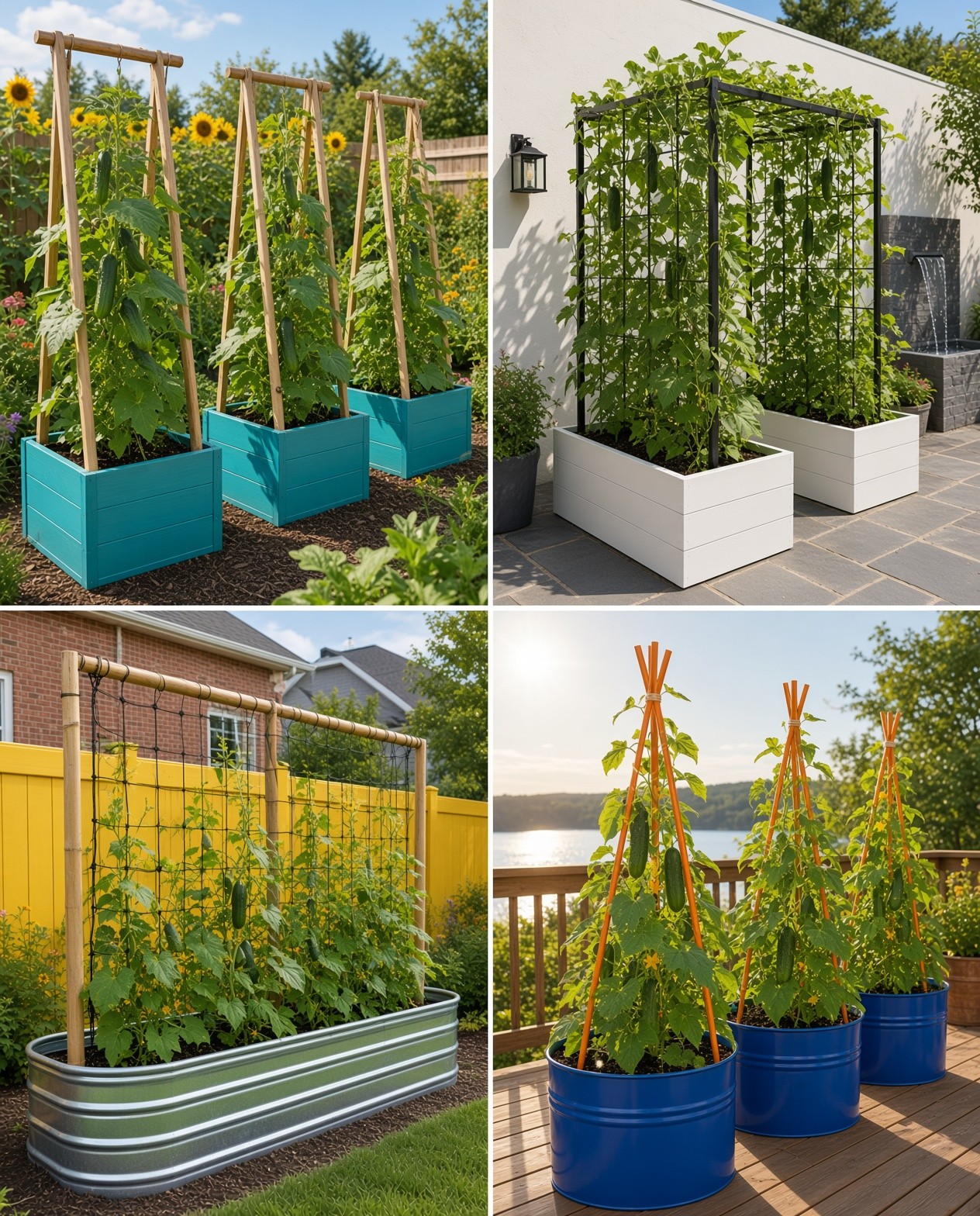
Grow more cucumbers in less space with simple, sturdy supports that make vines easier to manage and fruit easier to harvest.
Why Grow Cucumbers Vertically?
Cucumbers are vigorous vines, and giving them something to climb can transform the way a garden bed is used. A vertical support keeps vines off the soil, improves access to the fruit, and makes it easier to see when cucumbers are ready to pick. It can also make a productive garden feel much less crowded.

The best support is not necessarily the fanciest one. Cucumbers need a structure that is tall enough, stable enough, and easy for tendrils to grip. Bamboo, wood, strong garden string, wire mesh, and other simple materials can all become useful trellises.

Below are 13 practical ideas, from quick budget structures to more permanent garden features. Choose the one that fits your growing space, cucumber variety, and the amount of work you want to put into building it.

1. A-Frame Trellis
An A-frame is one of the simplest cucumber supports to build. Lean two matching sets of sturdy poles together, connect them at the top, and add horizontal supports or netting across the sides.

The angled shape gives vines plenty of climbing room while keeping the footprint relatively narrow. It is especially useful beside a raised bed because cucumbers can grow upward without taking over the walking path.

Use strong stakes or poles and anchor the bottom ends firmly. Once vines are covered with foliage and fruit, the structure catches more wind and becomes heavier, so stability matters.

2. Bamboo Teepee
A bamboo teepee brings a natural look to a vegetable garden while providing several climbing surfaces. Push three or more long bamboo poles into the soil in a circle, bring the tops together, and secure them tightly.

Plant cucumbers around the outside of the circle. As the vines grow, gently guide them toward the poles and let their tendrils find the support.

This design works particularly well for compact gardens and containers. It is quick to assemble, inexpensive, and easy to dismantle when the growing season ends.

3. String Trellis
A string trellis is one of the most budget-friendly choices. Set two strong posts at opposite ends of the planting area and run several horizontal lines of durable garden twine between them.

As each cucumber vine grows, gently guide it toward the nearest string. The tendrils will begin wrapping around the support as the plant climbs.

Use weather-resistant twine and make the top attachment secure. Thin household string can break under the weight of a mature vine, especially after rain.

4. Cattle-Panel Arch
A cattle panel can become an impressive cucumber tunnel with very little modification. Bend a long livestock panel into an arch and secure both sides firmly in the ground or to sturdy posts.

Plant cucumbers along the edges. The vines can climb over the curved surface, eventually creating a green tunnel covered with foliage and hanging fruit.
The arch is strong enough for vigorous growth and can double as a shaded passageway. Leave enough room underneath for comfortable access and harvesting.
5. Wooden Lattice
A wooden lattice panel gives cucumbers a broad climbing surface and can be incorporated into the design of a raised bed, fence, or garden wall.
Choose a panel with openings small enough for young tendrils to grab. Position it securely before the plants become large, because installing a support through mature vines can cause unnecessary damage.
A lattice trellis also looks tidy in ornamental vegetable gardens. If you want the structure to last for several seasons, use outdoor-rated materials and keep the lower wood from sitting constantly in wet soil.
6. Garden-Net Trellis
Garden netting is lightweight and easy to install. Attach it between two sturdy posts or along a simple frame, then plant cucumbers at the base.
Netting is especially useful when you have several plants because it creates a broad vertical wall without requiring many rigid supports. The open mesh gives tendrils plenty of places to grab.
Choose strong, weather-resistant netting rather than flimsy decorative mesh. Check the tension occasionally as the vines become heavier.
7. Fence-Line Trellis
A sunny fence can become a ready-made cucumber support. If the fence has openings that tendrils can grip, simply train young vines toward it.
For a solid fence, attach horizontal wire, trellis netting, or narrow wooden battens. Keep the attachment points strong enough to support mature vines.
This approach is excellent for small gardens because it turns an otherwise unused vertical surface into growing space. Make sure the fence receives enough sunlight for healthy cucumber production.
8. Pallet Trellis
A clean, sturdy wooden pallet can be repurposed into a rustic vertical garden feature. Stand it securely and anchor it so it cannot tip forward as the vines grow.
Cucumbers can climb through the openings, although a little extra string or mesh may help guide young stems. Use a pallet made from safe, suitable wood and avoid questionable salvaged timber.
Because pallets are heavy, stability is the priority. A pallet that looks secure when empty may become top-heavy once covered in foliage.
9. PVC Frame
PVC pipe makes a lightweight frame that is easy to customize. Connect straight sections with appropriate fittings to create a rectangle, arch, or A-frame, then attach garden netting or strong string.
One advantage of PVC is flexibility. You can build a structure to fit almost any bed, and the frame is easy to take apart at the end of the season.
Anchor the frame well. Lightweight tubing can move or lift in strong wind unless the base is secured.
10. Obelisk Trellis
An obelisk creates a tall focal point while giving cucumber vines several surfaces to climb. It can be made from wood, bamboo, or sturdy garden poles.
Place the structure in the bed before the cucumber becomes large. Train the first few feet of growth around the lower supports, then allow the plant to climb naturally.
Because the design is narrow at the top, it works well where floor space is limited. It can also be attractive enough to use in a mixed edible-and-ornamental planting.
11. Raised-Bed End Trellis
If you grow cucumbers in a raised bed, use the short end of the bed as the foundation for a vertical frame. Secure two tall posts and connect them with horizontal rails or netting.
The vines grow upward at the end of the bed instead of sprawling across valuable planting space. This leaves more room for herbs, greens, or compact vegetables in front.
Keep the support outside the main planting area where possible, and make sure it is anchored deeply enough to resist the weight of mature vines.
12. Reclaimed Branch Trellis
Straight branches can make a charming rustic support when you have suitable untreated material available. Arrange sturdy branches into a simple ladder, fan, or teepee shape and tie the joints securely.
This style works best with smaller cucumber varieties and a sheltered garden location. Inspect branches for weakness before using them and replace any that crack or rot.
The result can blend beautifully into a natural garden while costing almost nothing. It is also a practical way to use suitable pruned branches instead of discarding them.
13. Overhead Pergola Trellis
For a dramatic option, train cucumbers over the top of a strong pergola-like frame. Plant the vines near the base and guide them upward until they reach the overhead grid.
Once established, the foliage can create a green canopy, with cucumbers hanging down where they are easier to spot. This can be particularly useful for gardeners who enjoy growing vegetables as part of a garden structure.
Make sure the frame is genuinely strong enough for the mature crop. An overhead design should never rely on flimsy decorative supports.
How to Choose the Right Trellis
The best cucumber trellis is the one that matches your space, variety, and growing conditions. Compact gardens often benefit from A-frames, teepees, or narrow obelisks. Long beds can make good use of string or netting, while larger spaces can accommodate arches and pergolas.
Also consider how you will harvest. A support that makes fruit visible and reachable is more useful than one that simply looks attractive. Leave enough clearance around the planting so you can inspect leaves and pick cucumbers without stepping on vines.
Install the support before the plants become tangled. Young vines are much easier to guide than mature stems.
Keep the Structure Strong
Cucumbers may look delicate when young, but a mature vine can become surprisingly heavy. Wind, rain, foliage, and fruit all add weight, so a trellis should be anchored before the plant climbs high.
Check joints and ties during the season. If a post begins leaning, correct it early rather than waiting until the vine has completely covered the structure.
With the right support, vertical cucumber growing becomes easier to manage, easier to harvest, and much more productive in a limited space.