
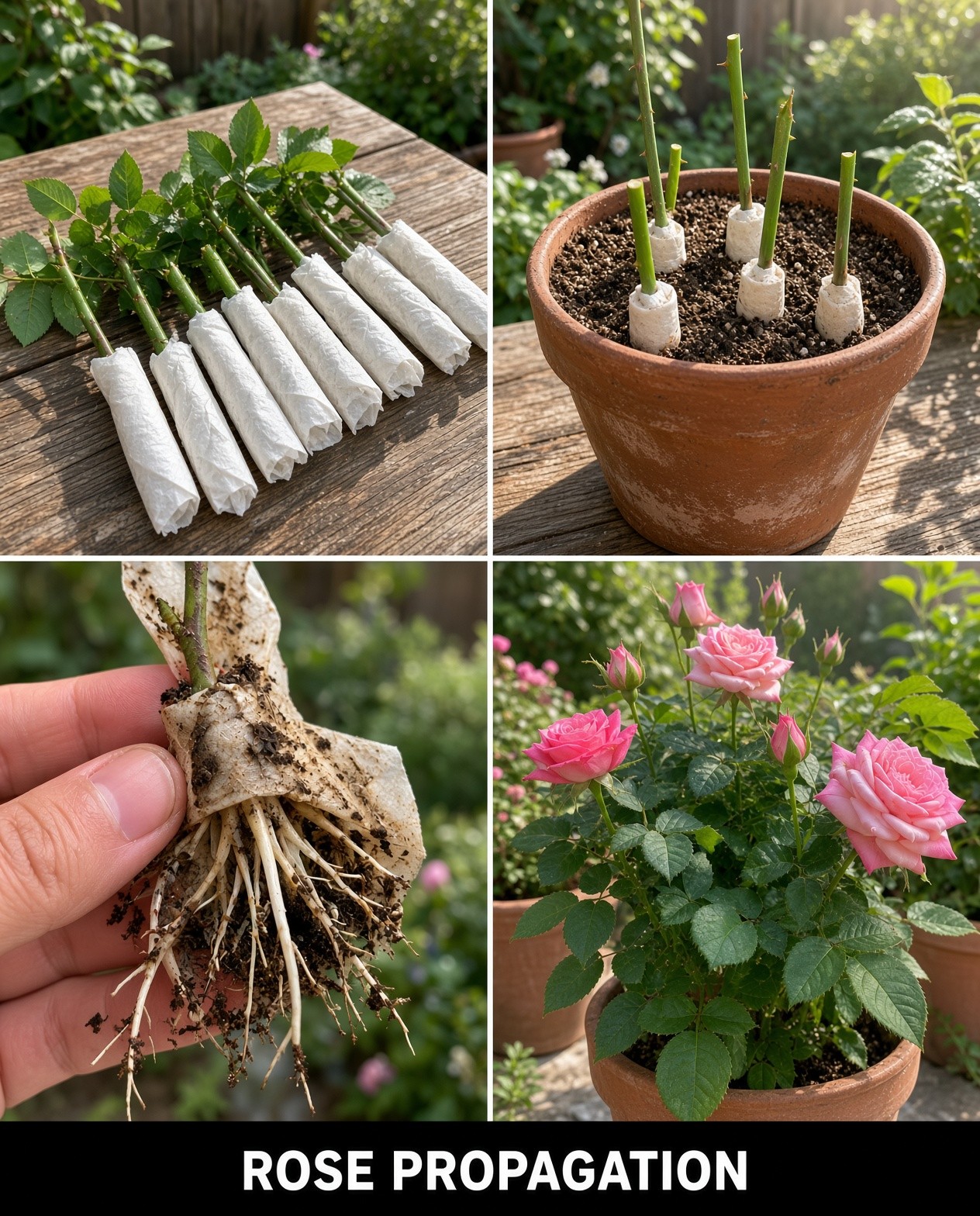
Want more roses without buying another mature plant? Growing roses from stem cuttings is an affordable gardening project. The toilet-paper technique is a moisture-retaining variation that some gardeners experiment with, but the paper itself does not make roots grow. This guide explains how to prepare cuttings, manage humidity, avoid rot, and care for young plants.
Choose a healthy rose and suitable stem
Start with a healthy rose that shows no obvious pests, black spot, mildew, or wilting. A vigorous shoot that has recently finished flowering is often a useful candidate. Semi-hardwood growth—firming up but not yet old and woody—can root well in suitable conditions. The best season varies by climate; many gardeners take cuttings in late spring or summer, while others have success in early autumn where the weather remains mild. Choose a stem roughly pencil-thick and take several cuttings because not every one will root. Keep them cool and shaded while you prepare them.

Prepare each cutting cleanly
Use sharp, clean bypass pruners or a knife. Make the bottom cut just below a leaf node and the top cut just above a node. Aim for a cutting around 10–15 cm (4–6 inches) long with at least two or three nodes. Remove flowers, buds, and leaves from the lower half. Keep one or two healthy leaf sets near the top; large leaves can be trimmed partly to reduce water loss. Avoid crushing the stem or stripping its bark. Clean tools help reduce the risk of transferring disease between plants.

Gather the materials
Prepare small pots with drainage holes, a clear plastic bag or propagation dome, clean water, and a light rooting medium. A blend of perlite with seed-starting mix or coir provides moisture while allowing air to reach the stem base. Avoid dense garden soil, which can stay wet and encourage rot. For the toilet-paper variation, choose plain, unscented paper without lotion or fragrance. A commercial rooting hormone is optional; if you use one, follow its label and do not overapply.

Understand what toilet paper does
The paper can hold a little moisture close to the cut end, but it does not contain the structure or air spaces of a rooting medium. It is not a rooting hormone and does not guarantee roots. If it becomes saturated and remains wrapped around the stem in a sealed environment, it may reduce airflow and encourage decay. Think of it as a temporary moisture wrap rather than the place where the rose should root. A clean, airy propagation mix remains the more dependable choice.

Try the paper wrap carefully
Lightly dampen a small piece of toilet paper and wrap it loosely around the lowest 2–3 cm of the cutting. It should cling gently, not form a thick, tight bundle. Do not soak it until it drips or cover the upper nodes and leaves. If using rooting hormone, apply it to the freshly cut base according to directions before wrapping. For a practical approach, remove the paper before inserting the cutting into the propagation mix. If you want to test the paper technique, compare it with a cutting planted directly into mix and monitor the wrapped stem closely.

Plant and create humidity
Make a hole in the damp mix with a pencil so the cutting is not scraped as it goes in. Insert the lower third of the stem and firm the medium gently. Water lightly to settle it. Cover the pot with a clear bag or propagation dome to maintain humidity, but keep plastic from touching the leaves by using small supports. Open the cover briefly each day for fresh air. Place the pot in bright, indirect light. Direct sun can overheat the enclosure, even when the air outside feels mild.

Keep moisture balanced
The rooting mix should remain lightly and evenly moist, never waterlogged. Check the pot regularly and water when the surface begins to dry. Empty standing water from saucers and remove fallen leaves. Heavy condensation that remains all day can signal poor ventilation; open the cover a little more. At the same time, do not let the cutting dry out. Consistency is more helpful than frequent heavy watering. Avoid fertilizer while the cutting has no roots, because it cannot use nutrients normally and concentrated fertilizer may damage tender tissue.

Recognize rooting without damaging it
Rose cuttings may take several weeks to root, and timing differs with variety, stem maturity, season, and conditions. New leaves do not prove that roots have formed: a cutting can push out growth using stored energy. Avoid repeatedly tugging on the stem, since delicate new roots can break. Look for steady growth and, where possible, roots visible near a drainage hole or through a clear container. A black, mushy stem or unpleasant smell suggests rot; remove failed cuttings promptly.

Pot up young roses gradually
When a cutting has developed a healthy cluster of roots, move it into a small pot of quality, free-draining potting mix. Handle the root ball gently and plant at about the same depth. Water to settle the mix, then keep the new plant in bright shade while it adjusts. Introduce stronger light and outdoor conditions gradually over a week or two. Do not rush a tiny cutting into a garden bed. Let it develop a sturdy root system and several healthy leaves first, and protect it from harsh wind and midday sun.

Avoid common propagation mistakes
The most common setbacks are unhealthy starting material, blunt or dirty tools, saturated paper, waterlogged soil, and direct sun on a covered pot. Some rose varieties root more readily than others, so failure does not always mean you did something wrong. Take multiple cuttings and label each variety and date. Also check whether the rose is a protected cultivar: local rules or plant variety rights may restrict propagation or distribution. Share plants only when you are sure it is permitted.
Run a simple comparison trial
If you are curious whether toilet paper helps, take six similar cuttings from one healthy rose. Plant three directly into the same propagation mix. Wrap the other three bases briefly with lightly damp paper, then plant them in identical pots and conditions. Label the groups and record which cuttings stay healthy, root, and produce sustained new growth. This small test gives you a better answer for your climate and rose variety than assuming the paper technique works for every plant.
Final thoughts
Growing roses from cuttings is an inexpensive way to multiply a favorite garden plant, but patience and steady care matter more than any shortcut. The toilet-paper method is best treated as a moisture-management experiment, not a guaranteed rooting trick. Start with healthy stems, make clean cuts, use an airy medium, maintain humidity without waterlogging, and wait for genuine root development before potting on. With several cuttings and careful observation, you give yourself a much better chance of raising strong new roses.
Quick Reference: Rose Cutting Basics
| Detail | Guideline |
|---|---|
| Cutting length | About 10–15 cm (4–6 inches) |
| Stem | Healthy, firming growth, roughly pencil-thick |
| Nodes | Two or three or more |
| Rooting medium | Light, clean, free-draining mix |
| Light | Bright, indirect light |
| Moisture | Evenly moist, never waterlogged |
| Rooting time | Several weeks; varies by variety and conditions |
Frequently Asked Questions
Can toilet paper really help rose cuttings root?
It can temporarily hold moisture around the base, but it is not a rooting hormone or growing medium. Root formation depends on the cutting and its environment. A clean, airy propagation mix is the more dependable foundation.
Should the paper stay wrapped around the stem for weeks?
No. A wet paper wrap sealed around the stem for a long period can reduce airflow and encourage rot. If you experiment with it, keep it lightly damp and monitor it closely.
How long do rose cuttings take to root?
There is no fixed timetable. Some root within several weeks; others take longer or fail. Variety, temperature, stem maturity, humidity, and watering all affect the result.
Can I use a stem from a bouquet?
Sometimes, but florist stems may be dehydrated, old, or treated. Fresh cuttings from a healthy garden rose are usually a better starting point.
When can I plant a new rose outdoors?
First grow it in a pot until it has a healthy root system and sturdy new growth. Acclimate it gradually, and avoid planting during extreme heat, cold, or drought.
Conclusion
Propagating roses from cuttings is a rewarding way to multiply a favorite plant. The toilet-paper approach is best understood as a small moisture-management experiment, not a guaranteed shortcut. Clean tools, healthy stems, an airy rooting mix, indirect light, and careful watering are the real foundations of success. Take several cuttings, compare methods if you are curious, and give young plants time to establish before moving them into the garden.