
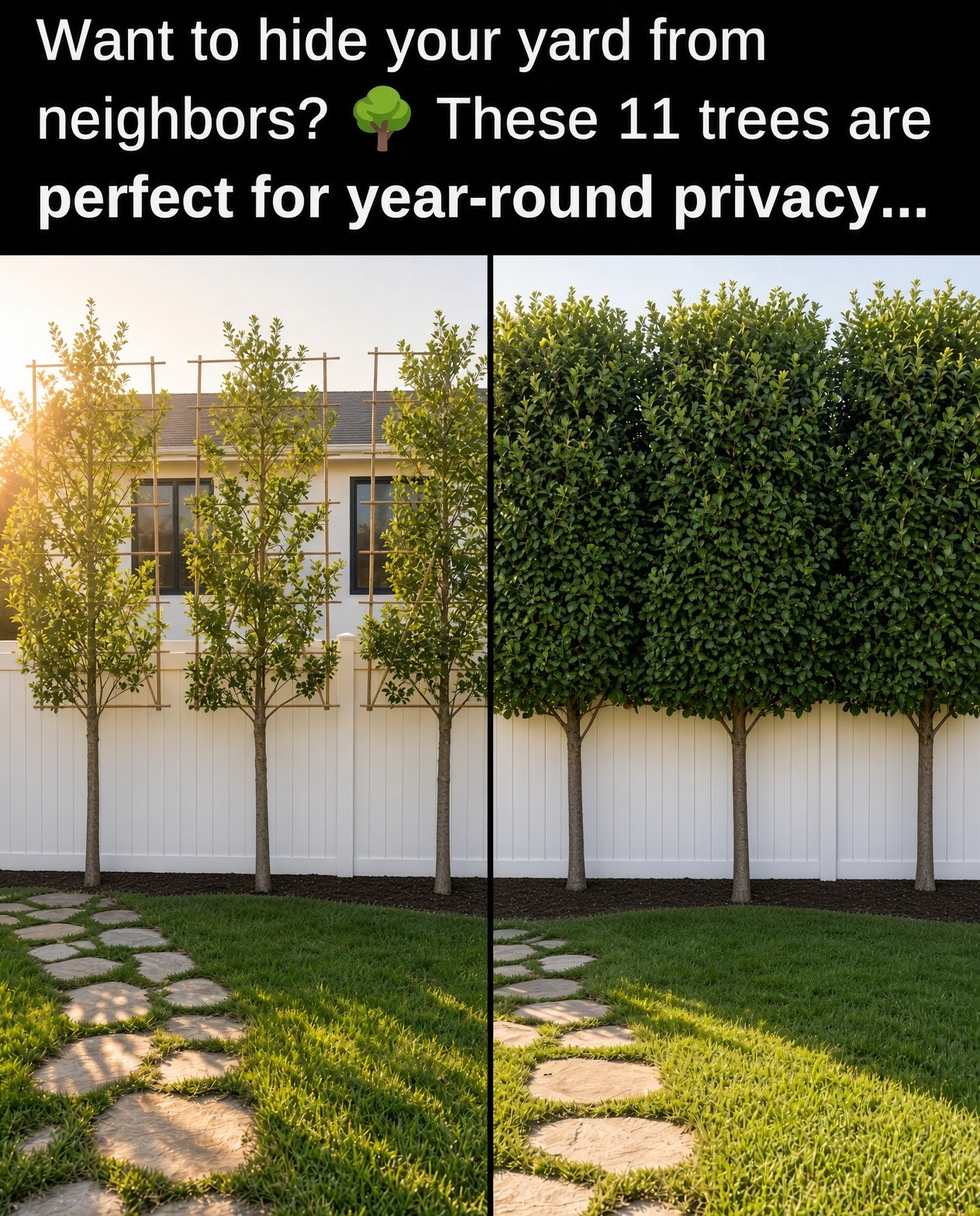
If your garden becomes exposed every winter because deciduous trees drop their leaves, an evergreen privacy screen can offer a more consistent solution. Evergreen trees and large shrubs keep foliage through the cold season, creating structure and visual separation when many other plants are bare. The best choice depends on your climate, available space, soil, sunlight, mature size, and willingness to prune.
Why Evergreen Trees Work So Well for Privacy
Evergreen plants are useful for privacy because they retain foliage through the seasons instead of becoming completely bare in winter. That makes them valuable as screens, backdrops, windbreaks, and garden boundaries. Still, evergreen does not mean leafless of maintenance: older foliage is naturally replaced and drops over time, usually without destroying the overall screen.

1. Eastern Arborvitae (Thuja occidentalis)
Eastern arborvitae is one of the classic choices for a tall living screen. Its naturally dense, upright form works especially well when several plants are arranged in a row. Penn State Extension describes American arborvitae as a dense, often broad pyramid-shaped evergreen suitable for hedges and screens. Choose a cultivar whose mature height and width fit the property instead of assuming every arborvitae will remain narrow.

2. Western Redcedar (Thuja plicata)
Western redcedar is a substantial evergreen for gardeners with enough room for a large plant. Its dense foliage can create a strong visual barrier, but its eventual size makes it unsuitable for many small gardens. Before planting, check mature dimensions, drainage, exposure, and local climate. A tree can be evergreen and still be the wrong plant if the site cannot accommodate its mature canopy and roots.

3. English Yew (Taxus baccata)
English yew is useful when you want an evergreen screen that can also be trained into a formal shape. Yews tolerate pruning better than many conifers and their dense foliage creates a substantial barrier. However, yew foliage and seeds are toxic if eaten, so extra care is important around pets and children. Plant it in a suitable site and dispose of clippings responsibly.

4. Eastern Redcedar (Juniperus virginiana)
Eastern redcedar is a useful option for sunny sites where drought tolerance matters after establishment. Its evergreen foliage and upright habit can create privacy without requiring a tightly clipped hedge. It also has wildlife value. Give it enough room to develop naturally and avoid squeezing it into a bed that is too small for its mature dimensions.

5. Eastern Hemlock (Tsuga canadensis)
Eastern hemlock has a graceful pyramidal silhouette and soft, fine-textured foliage. It can create an impressive screen where conditions are suitable, especially when a woodland appearance is preferred over a rigid hedge. One important consideration is pest pressure: hemlocks can be affected by hemlock woolly adelgid. Monitor plants regularly and use regionally appropriate management if problems appear.

6. Southern Live Oak (Quercus virginiana)
Southern live oak is different from a narrow conifer screen. In warm climates it can remain evergreen while developing a broad, spreading canopy that provides shade as well as visual screening. That makes it particularly useful for larger landscapes. It is not a universal choice, however, because colder regions may not provide the conditions needed for it to remain evergreen.

7. Green Giant Arborvitae
Green Giant arborvitae is valued for vigorous vertical growth and a naturally conical shape. It can become a very tall screen, which is useful when the goal is to block a neighboring view. That same vigor means spacing matters. A row planted too closely can eventually become crowded and difficult to manage. Plan for the mature hedge, not the small nursery plants you buy today.

8. Holly (Ilex species)
Evergreen hollies bring glossy foliage and, on suitable female plants with pollination, colorful berries. Holly ranges from tree-sized forms to compact shrubs, so the species or cultivar matters. Penn State Extension notes that hollies vary widely and that some forms are useful for screening and hedging. Select according to mature size, climate, desired density, and whether fruit is wanted.

9. Leyland Cypress (× Cuprocyparis leylandii)
Leyland cypress is known for rapid growth and is often planted when gardeners want a tall screen quickly. Its speed can be an advantage, but it is not a maintenance-free solution. Fast-growing screening plants still need correct spacing, adequate water during establishment, and sensible pruning. If a hedge becomes too large for its site, correcting the problem later can be difficult.

10. Boxwood (Buxus species)
Boxwood is technically an evergreen shrub rather than a true tree, but it belongs in a privacy discussion because it can form exceptionally dense hedges. It is especially useful for lower screens, pathways, garden rooms, and formal boundaries. For a compact property, a dense shrub screen can sometimes be more practical than planting very large trees.

11. Wax Myrtle (Morella cerifera)
Wax myrtle is a warm-climate evergreen that can be grown as a large shrub or small tree-like plant. Its aromatic foliage adds sensory interest while dense growth provides screening. It should be considered where climate and soil conditions suit it. As with any vigorous privacy plant, give it room and check mature size before planting near paths, fences, foundations, or utilities.

How to Choose the Right Privacy Tree
The tallest or fastest-growing tree is not automatically the right one. Start with the job you need the plant to perform: block a view, hide a structure, reduce wind, frame a patio, or create a year-round green backdrop. Then compare mature height, mature width, sunlight, soil drainage, hardiness, drought tolerance, and pruning needs. Choosing the right plant for the right place usually prevents future maintenance problems.

Planting and Maintenance Tips
Evergreen screening plants need care, especially while becoming established. Water newly planted trees consistently according to local conditions, avoid chronic drought and waterlogging, and keep mulch away from trunks. Spacing is equally important: an attractive young row can become overcrowded if every plant is installed too close together. Prune according to the species and its natural growth habit instead of repeatedly forcing a large tree into a much smaller space.

Evergreen Does Not Mean Zero Leaf Drop
One common misconception is that an evergreen never drops foliage. In reality, evergreens continuously replace older leaves or needles. Penn State Extension explains that foliage can have different lifespans depending on species, and older interior foliage may yellow, brown, and fall. A little seasonal shedding is normal. Sudden or excessive browning, however, deserves attention because drought, transplant stress, pests, disease, or winter injury can cause abnormal damage.

Final Thoughts
A successful privacy planting should feel like part of the landscape rather than a wall that constantly needs rescuing. Arborvitae, redcedar, yew, hemlock, holly, boxwood, wax myrtle, and other evergreens each have different strengths. Compare mature dimensions and site requirements before planting, then give the screen enough room, water, and care to establish properly. With the right match, an evergreen screen can provide privacy, greenery, and garden structure for years.