
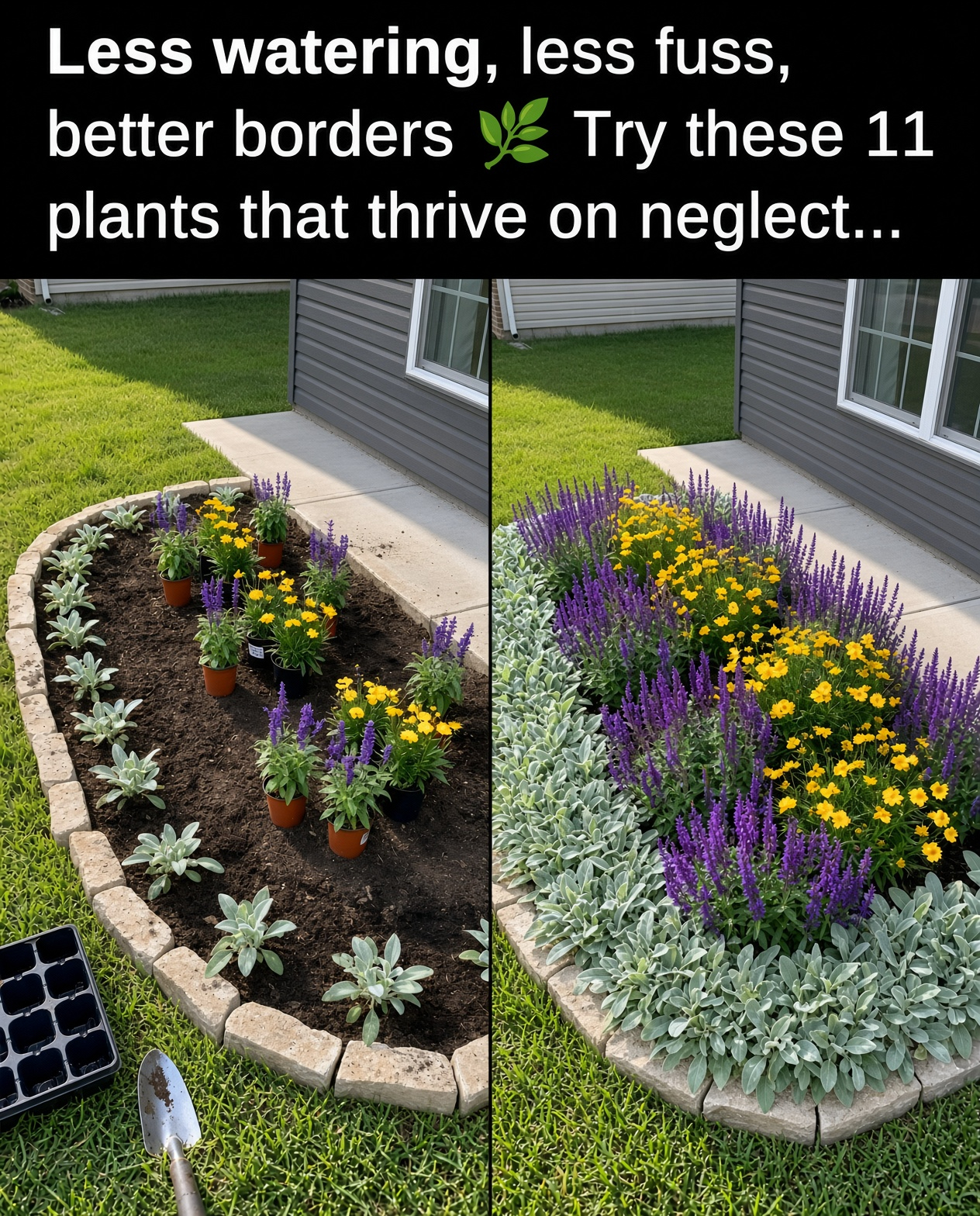
11 Easy-Care Plants for Garden Borders That Need Less Fuss
A beautiful garden border does not have to mean endless watering, pruning, deadheading, and dividing. The easiest way to reduce maintenance is to choose plants that naturally stay manageable, tolerate periods of dry weather, and don’t constantly demand attention.
That doesn’t mean these plants should literally be abandoned. Even tough perennials need the right planting conditions and some care while they establish. But once they’re settled in, the right choices can make a border considerably easier to maintain.

What Makes a Plant Easy-Care for a Border?
Before choosing plants, think about what actually makes a border low-maintenance. The best candidates generally have several useful characteristics rather than just one.
- They tolerate dry periods: established plants can cope with less frequent watering when growing in suitable conditions.
- They have a naturally tidy habit: clumping plants are particularly useful because they tend to stay where you put them.
- They need limited grooming: plants that don’t require constant deadheading save considerable time.
- They return reliably: perennial plants can provide structure year after year.
- They aren’t aggressive spreaders: this is especially important along a defined border.
The original selection focuses on plants that are relatively low-maintenance and suitable for controlled borders rather than plants that aggressively take over surrounding space.
1. Catmint
Nepeta × faassenii is a classic choice for a sunny border. Its soft gray-green foliage forms attractive mounds, while spikes of blue-purple flowers can continue appearing over a long flowering period.
Catmint is particularly useful where you want a plant that combines flowers with drought tolerance. It also attracts pollinators, giving a border plenty of activity without requiring complicated care.
Because many commonly grown catmint hybrids are sterile or have limited seed production, they are much easier to control than aggressively spreading plants. A light trim after flowering can also encourage fresh growth.
2. ‘Moonbeam’ Coreopsis
If you want cheerful color without a demanding plant, look at threadleaf coreopsis, particularly the popular ‘Moonbeam’ cultivar.
Coreopsis verticillata ‘Moonbeam’ forms a manageable clump rather than behaving like an aggressive groundcover. Its fine foliage creates a delicate texture, while the pale yellow flowers provide a long-lasting display.
Once established in a sunny location, it handles heat well and generally needs little attention. That makes it particularly useful along the front or middle of a perennial border.

3. Russian Sage
Russian sage, traditionally known as Perovskia atriplicifolia, brings a completely different texture to the border. Its upright stems and silvery foliage are topped with airy blue-purple flowers.
This plant is particularly useful when the border needs height without becoming visually heavy. The silver stems and foliage also create an attractive contrast beside green-leaved plants.
Russian sage is tolerant of poor soil once established and prefers plenty of sunlight and good drainage. It is therefore a strong candidate for a hot, dry section of the garden.

4. ‘Autumn Joy’ Sedum
‘Autumn Joy’ sedum is especially valuable when you want a border to remain interesting late into the growing season.
This clumping perennial develops fleshy foliage and broad flower clusters that change character as the season progresses. The flowers can move from pale tones into richer pink and reddish shades as autumn approaches.
The succulent-like foliage also helps established sedums cope with dry conditions. Instead of demanding frequent watering, this is a plant that generally prefers well-drained soil and plenty of sun.

5. ‘Silver Carpet’ Lamb’s Ear
For a border that needs texture rather than another large splash of color, lamb’s ear is hard to overlook.
Stachys byzantina ‘Silver Carpet’ produces low-growing mats of thick, fuzzy, silvery leaves. The unusual foliage immediately separates it from ordinary green border plants.
This type is especially useful as an edging plant because its low profile helps define the front of a bed. It prefers sunny conditions and soil that does not remain excessively wet.
The non-flowering ‘Silver Carpet’ type is also useful when you want the foliage itself to remain the main attraction.

6. Clump-Forming Daylilies
Daylilies can make excellent low-maintenance border plants, but variety selection matters. Instead of choosing a type simply because it looks attractive, look for named cultivars with a well-behaved clumping habit.
‘Stella de Oro’ is a familiar example. Its golden-yellow flowers stand above narrow green foliage and can provide repeated color during the growing season.
Daylilies tolerate a range of conditions and generally require little specialist care once established. Give them enough space to form their clumps without crowding neighboring plants.

7. Lavender
Lavender is one of the most recognizable choices for a sunny, low-maintenance border. Lavandula angustifolia forms tidy mounds of aromatic foliage and produces spikes of purple flowers.
Its biggest requirement is good drainage. Lavender generally performs much better in soil that does not remain saturated, especially through winter.
Once established, it is well adapted to dry conditions. Its flowers also provide an important food source for bees and other pollinators.
A light annual trim can help maintain a compact shape, but avoid cutting deeply into old, woody growth.

8. Globe Thistle
Globe thistle is perfect when you want something more architectural. Echinops ritro produces round blue flower heads that appear almost like small ornaments above the foliage.
The plant forms clumps rather than spreading through underground runners, which makes it much easier to manage as part of a defined planting scheme.
It prefers full sun and well-drained soil and is capable of handling dry conditions once established. Bees are also attracted to its flowers, giving the border additional wildlife value.
The main thing to watch is self-seeding. If you don’t want seedlings appearing elsewhere, remove mature flower heads before they release their seeds.

9. Clumping Yarrow
Yarrow can be an excellent border plant, but this is another case where choosing the right cultivar matters.
Clumping selections such as ‘Moonshine’ are much better suited to a controlled ornamental border than forms that spread aggressively. ‘Moonshine’ combines fine, gray-green foliage with flat clusters of yellow flowers.
It performs particularly well in sunny, relatively dry conditions and can tolerate heat once established.
Keep the planting compact by choosing a well-behaved cultivar rather than assuming every yarrow behaves in exactly the same way.

10. Blue Fescue
Not every border needs to be filled with flowers. Blue fescue provides color and structure through its foliage alone.
Festuca glauca forms compact rounded tufts of narrow blue-gray leaves. These clumps are particularly effective along the front of a border, beside pathways, or between flowering perennials.
Its evergreen or semi-evergreen character, depending on climate, helps maintain structure outside the main flowering season. Plant it in full sun with good drainage for the best results.

11. Bergenia
Bergenia brings bold foliage to the border. Unlike the fine textures of blue fescue or yarrow, Bergenia cordifolia produces large, rounded leaves that provide a strong visual anchor.
Its foliage can remain attractive for much of the year, while clusters of pink flowers appear in spring. This makes bergenia useful when you want a border to have structure even when fewer plants are flowering.
It is also a useful option when a border is not exposed to intense full sun all day. Depending on the climate and site, bergenia can handle sun or partial shade, particularly when it has adequate moisture.

How to Combine These Plants in One Border
The easiest way to make a low-maintenance border look intentional is to repeat plants instead of buying one of everything.
For the front edge, blue fescue and ‘Silver Carpet’ lamb’s ear can provide compact foliage. Catmint and ‘Moonbeam’ coreopsis can occupy the middle layer, while Russian sage and globe thistle can provide additional height farther back.
Lavender can repeat the silvery color, while ‘Autumn Joy’ sedum adds late-season interest. Daylilies can provide stronger vertical foliage and bright flowers, while bergenia can fill areas where broader foliage is desirable.

Low-Maintenance Does Not Mean No Maintenance
There is an important difference between an easy-care plant and a plant that can simply be forgotten.
Even drought-tolerant perennials need regular watering while they establish. They also need suitable soil, enough sunlight for their particular requirements, and occasional cleanup when growth becomes damaged or overcrowded.
The advantage is that you aren’t constantly fighting the natural growth habit of the plant. Choosing a clumping cultivar instead of an aggressive spreader can save far more work over several years.
Quick Guide to the 11 Plants
| Plant | Best Quality | Useful Border Position |
|---|---|---|
| Catmint | Long flowering and drought tolerance | Front or middle |
| ‘Moonbeam’ Coreopsis | Heat tolerance and yellow flowers | Front or middle |
| Russian Sage | Silvery foliage and height | Middle or back |
| ‘Autumn Joy’ Sedum | Late-season color | Middle |
| ‘Silver Carpet’ Lamb’s Ear | Silvery textured foliage | Front edge |
| Clump-Forming Daylily | Reliable colorful flowers | Middle |
| Lavender | Fragrance and drought tolerance | Front or middle |
| Globe Thistle | Bold spherical flowers | Middle or back |
| Clumping Yarrow | Fine foliage and long-lasting flowers | Front or middle |
| Blue Fescue | Compact blue-gray foliage | Front edge |
| Bergenia | Large evergreen foliage | Front or middle |
Final Thoughts
A low-maintenance border starts with choosing plants that naturally fit the job. Catmint, ‘Moonbeam’ coreopsis, Russian sage, ‘Autumn Joy’ sedum, ‘Silver Carpet’ lamb’s ear, clump-forming daylilies, lavender, globe thistle, clumping yarrow, blue fescue, and bergenia each bring a different combination of flowers, foliage, texture, and structure.
The important part is not to interpret “easy-care” as “ignore it.” Give plants the conditions they need, water them properly while establishing, and keep an eye on varieties that can spread by seed.
Once established in the right location, these plants can give you a border that stays attractive without demanding your attention every day.