
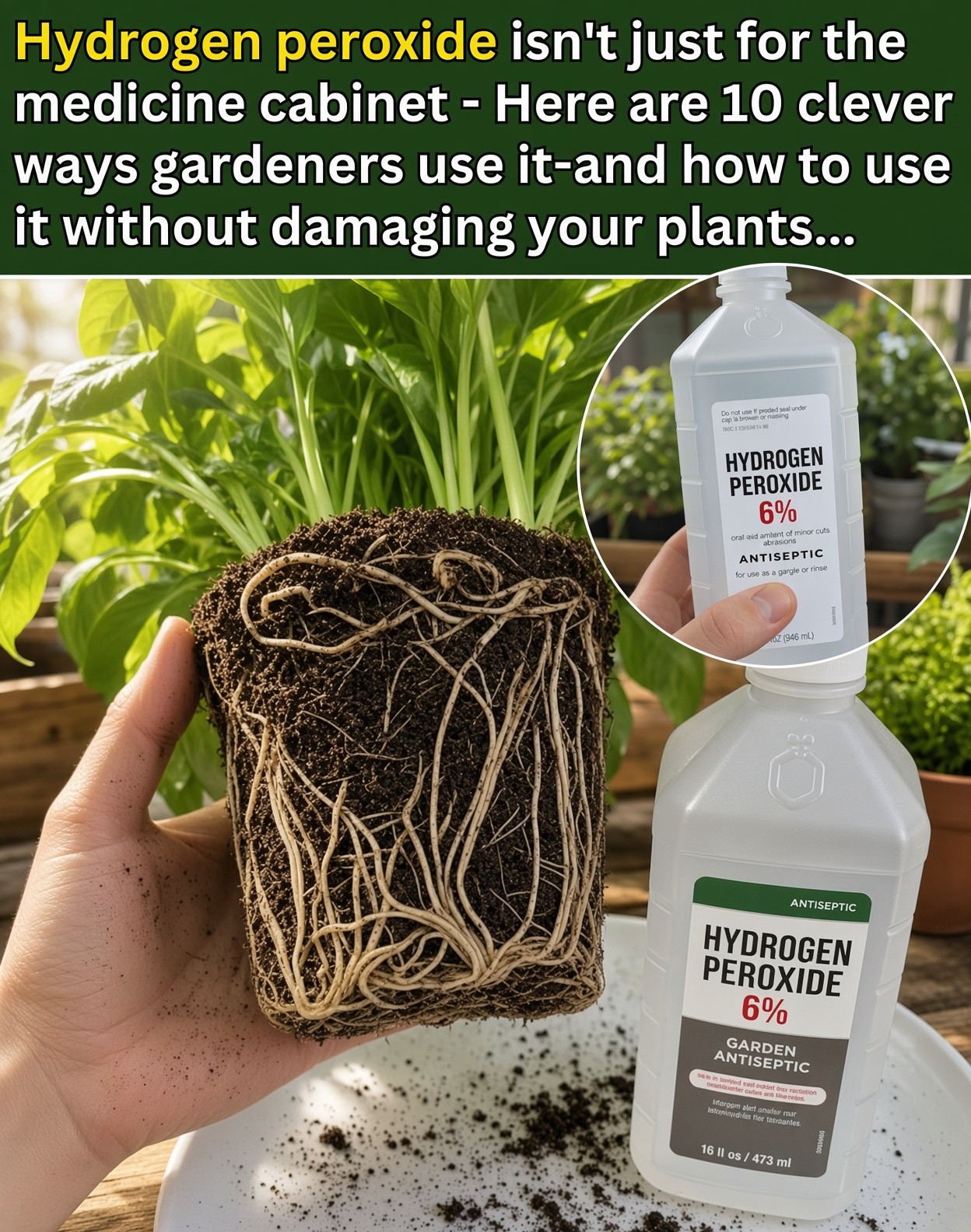
Hydrogen Peroxide in the Garden: What Gardeners Should Know
Hydrogen peroxide is often mentioned as a simple household product that can be useful around plants. The appeal is easy to understand: a small bottle is inexpensive, familiar, and breaks down into water and oxygen. Gardeners have suggested diluted solutions for everything from seed preparation and cleaning tools to dealing with some pest and disease problems. But it is important to separate a useful garden practice from an internet shortcut. Hydrogen peroxide is an oxidizer, and stronger solutions can injure plant tissue. The safest approach is to use only a labeled product, follow directions, test a small area first, and avoid treating healthy plants unnecessarily.

1. It May Help With Seed Preparation
Healthy seed, fresh growing media, correct temperature, moisture, and good sanitation are the foundations of successful germination. Some gardeners use a very dilute hydrogen peroxide solution as an additional seed-treatment step because the oxidizing compound may help reduce microorganisms on the seed surface. The idea is not to replace good seed-starting practices. If you experiment, keep the concentration low, avoid prolonged exposure, rinse when appropriate for the seed, and compare results with untreated seed. Good drainage and clean containers remain more important than any homemade treatment.

2. It Can Be Part of a Root-Rot Prevention Routine
Root rot is usually a moisture-management problem as much as a disease problem. When soil stays saturated, roots have less access to oxygen and conditions become favorable for several root pathogens. A hydrogen peroxide solution is sometimes promoted as a way to add oxygen temporarily, but it should not be used as a substitute for fixing poor drainage or overwatering. Let containers drain freely, choose an appropriate potting mix, and water according to the plant’s needs. If roots are already rotting, remove damaged tissue and correct the growing conditions first.

3. It Has Oxidizing Properties That Can Affect Microorganisms
Hydrogen peroxide can damage microorganisms through oxidation, which explains why it appears in many cleaning and sanitation products. In gardening, that property is sometimes used in diluted sprays or cleaning solutions. The important limitation is that an oxidizer does not distinguish perfectly between organisms you dislike and organisms you want to keep. Soil contains a complex community of bacteria, fungi, and other organisms. Broadly applying peroxide can disturb that community as well as unwanted microbes. Use it for a specific reason rather than treating the entire garden as though it needs sterilization.

4. It Can Help With Garden Sanitation
Garden sanitation is one of the most dependable ways to reduce disease spread. Soil, sap, and plant debris can remain on pruners, scissors, pots, stakes, and other equipment and transfer pathogens from one plant to another. Hydrogen-peroxide-based disinfectants are used for some sanitation jobs, but the product label and required contact time matter. First remove visible dirt, then disinfect the cleaned surface with an appropriate product. Never mix disinfectants together. Extension guidance also emphasizes cleaning and disinfecting tools between infected plants, especially when a disease can spread mechanically.

5. It Can Be Useful for Cleaning Reusable Containers
Used seed trays and pots can carry old soil, algae, plant debris, and disease organisms. A cleaning routine is therefore more valuable than simply buying a new bottle of treatment each season. Scrub containers thoroughly to remove soil and residue, rinse them, and then use a suitable disinfectant according to its label. If you choose a hydrogen-peroxide-based product, make sure it is intended for the surface and purpose. Allow containers to dry before filling them again. Clean containers are particularly helpful when starting seedlings, where damping-off can destroy young plants quickly.

6. It May Be Considered for Some Pest Problems, But Caution Matters
Hydrogen peroxide is sometimes recommended online for aphids, fungus gnats, mites, and other garden pests. The challenge is that a concentration strong enough to affect insects can also injure leaves, flowers, roots, or beneficial organisms. Pest control works best when you first identify the pest and choose a treatment designed for that problem. If a peroxide-based product is specifically labeled for the use, follow that label. Avoid broad spraying simply because a homemade recipe promises to eliminate every pest. Targeted control is safer and usually more effective.

7. It Can Be Used Around Some Hydroponic Sanitation Tasks
Hydroponic systems depend on clean equipment, good water management, and adequate oxygen around the roots. Root diseases can become serious when water quality, temperature, circulation, or sanitation is poor. Hydrogen-peroxide-based products are used in some sanitation systems, but a home grower should not improvise a concentration without checking the product instructions. Too much oxidizer can damage roots and disrupt a living system. Start with clean reservoirs and equipment, maintain appropriate circulation and aeration, and remove diseased plant material promptly. Treat peroxide as a specialized tool, not the foundation of hydroponic care.

8. It Can Help Clean Garden Décor and Water Features
Birdbaths, fountains, and decorative containers can collect algae and organic residue. Cleaning these features regularly is more reliable than repeatedly adding a chemical and hoping the problem disappears. Empty the feature, scrub away visible buildup, rinse thoroughly, and use a suitable cleaner or sanitizer when needed. If a hydrogen-peroxide-based product is used, follow its label and consider the presence of birds, fish, pets, and other wildlife. Never assume that a household chemical is automatically harmless outdoors. A clean water feature and regular maintenance are the best first steps.

9. Compost Needs Balance More Than Chemical Additions
Compost decomposes because a diverse community of microorganisms breaks down carbon-rich and nitrogen-rich materials under the right conditions. Moisture, oxygen, particle size, temperature, and the balance of ingredients all matter. Some garden articles suggest hydrogen peroxide as a way to accelerate composting, but routine peroxide additions are not necessary for a healthy pile and can interfere with the microbial activity that actually drives decomposition. Instead, turn compacted material, add dry or fresh ingredients as needed, and keep the pile damp but not soggy. Good compost management is more dependable than a chemical shortcut.

10. It Is Sometimes Suggested for Stressed or Wilted Plants
Wilted plants need a diagnosis before they need a treatment. Drought, heat, damaged roots, compacted soil, pests, nutrient problems, and disease can all produce similar symptoms. Because peroxide can oxidize living tissue, pouring a strong solution around a struggling plant can make a problem worse. Start by checking the soil moisture and the roots, then correct watering, drainage, light, or temperature. If a peroxide product is labeled for the plant and problem, use it exactly as directed and test a small area first. Do not treat wilting as proof that the plant needs extra oxygen.

Use the Right Concentration and Follow the Label
Household hydrogen peroxide is commonly sold at a 3 percent concentration, but not every peroxide product is interchangeable. Concentrated products can cause serious burns and plant injury, while even dilute solutions can damage sensitive foliage if used incorrectly. Do not increase a recipe because a stronger solution seems more powerful. Read the product label, use the intended application rate, wear the protective equipment it specifies, and keep the container away from children and pets. Never mix hydrogen peroxide with other cleaners or garden chemicals unless the product label explicitly says the combination is safe.

Test Before Treating the Whole Plant
A small test is one of the simplest ways to reduce accidental damage. Apply the prepared solution to a limited area and observe the plant before treating the entire crop. Check for spotting, bleaching, curling, or other signs of stress over the following day or longer when appropriate. Sensitive plants, tender new growth, flowers, and leaves exposed to strong sunlight may react differently from tougher foliage. Testing cannot guarantee safety, but it is far better than discovering a problem after every plant in a bed has been sprayed.

Focus First on the Basics of Healthy Gardening
Hydrogen peroxide should never distract from the fundamentals that keep plants healthy. Good drainage, appropriate watering, sufficient light, clean tools, healthy planting material, air circulation, correct spacing, and regular pest scouting prevent many problems before a treatment is needed. Extension guidance for home gardens emphasizes these practices for disease management, while sanitation guidance recommends cleaning visible debris before disinfecting tools and containers. If a garden problem keeps returning, identify the underlying cause rather than relying on repeated chemical applications.

When Hydrogen Peroxide Makes Sense
There are situations where a peroxide-based product can have a legitimate role, especially for cleaning or sanitation when the product is designed and labeled for that purpose. Its oxidizing action explains why it is useful in some disinfectants. What gardeners should avoid is treating hydrogen peroxide as a universal fertilizer, pesticide, fungicide, or cure-all. Many popular recipes online use concentrations or application schedules without enough evidence for every plant and situation. A careful gardener asks what problem is being solved, whether the product is labeled for that use, and whether a simpler method would work better.

Final Takeaway
Hydrogen peroxide can be a useful gardening tool when it is used for a clear, limited purpose and handled carefully. It may have a place in sanitation, some specialized growing systems, or certain seed and disease-management experiments, but it is not a replacement for healthy soil, correct watering, clean equipment, and good cultural practices. Treat the product as an oxidizing chemical rather than a harmless plant tonic. Start with the least aggressive solution that is appropriate for the labeled use, test before broad application, and stop if plants show damage. That approach keeps the garden safer while avoiding unnecessary treatments.
